Nikanor Ivanovich Bosoy
Nikanor Ivanovich Bosoy, the corpulent and rude chairman of the tenants' association at 302-bis Sadovaya Street in Moscow, is a minor but emblematic figure in the Moscow satire of The Master and Margarita. A practical and suspicious man by nature, he is also a chiseller and a crook, as Woland himself observes. His story, which unfolds over a single day, serves as a concentrated case study of the greed, cowardice, and institutional corruption that Woland's visit exposes. From his disastrous encounter with Koroviev to his surreal dream of a currency theatre, Bosoy's trajectory is a swift descent from petty officialdom to public humiliation and psychiatric confinement, illustrating how the regime's own mechanisms of control can be turned against its functionaries.
Identity and Background
Nikanor Ivanovich is introduced as the chairman of the tenants' association of the large, U-shaped building on Sadovaya Street where the late Berlioz and Styopa Likhodeev reside. He is a man of somewhat rude nature, a practical and prudent official who is also, as the narrative makes clear, a chiseller and a crook. He is married to Pelageya Antonovna. His position gives him control over the allocation of living space, a source of immense power and temptation in crowded Moscow. He is accustomed to receiving bribes in Soviet money for registering people, a practice he admits to but does not consider truly criminal. His world is one of petty graft, bureaucratic routine, and a constant, anxious calculation of personal advantage.
The Encounter with Koroviev and the Bribe
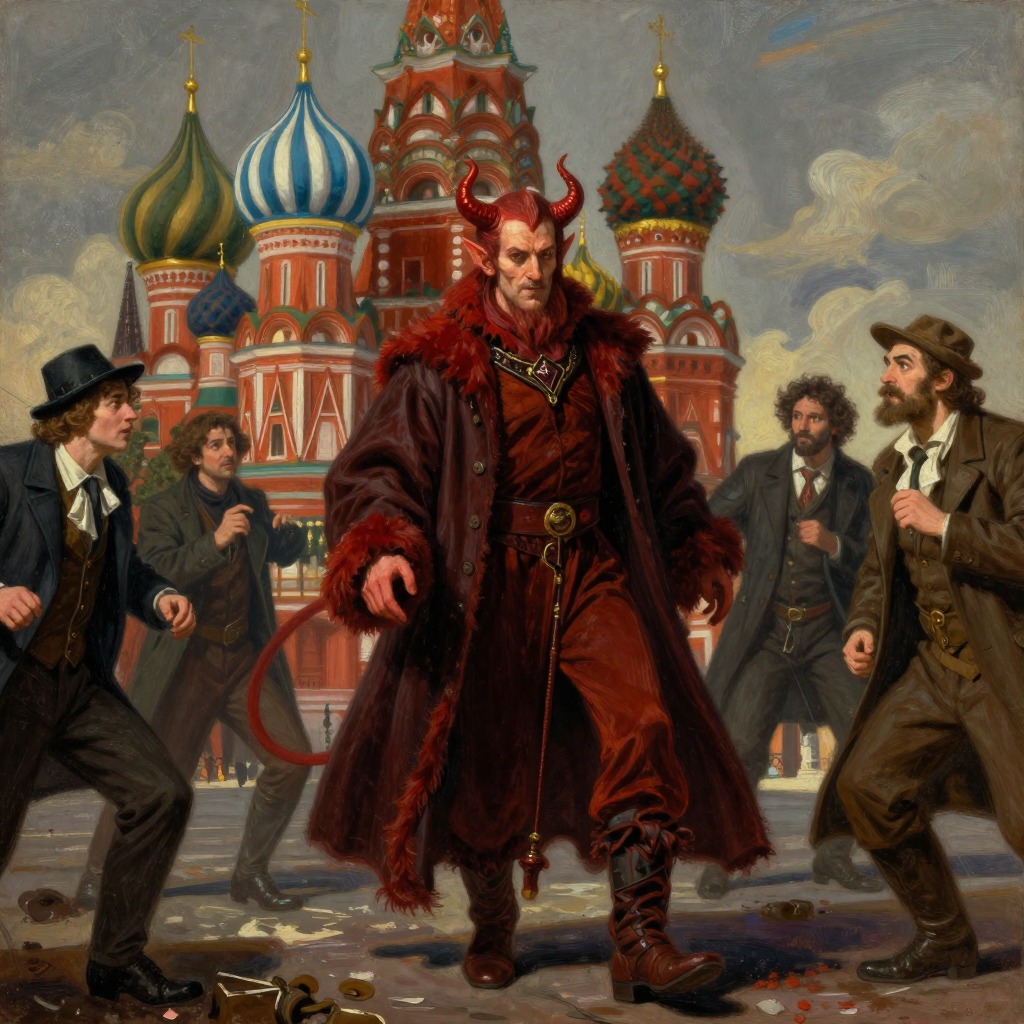
On the morning after Berlioz's death, Nikanor Ivanovich is besieged by desperate tenants seeking the deceased's living space. To escape them, he flees to the sealed apartment no. 50, where he discovers Koroviev, who introduces himself as an interpreter for the foreign artiste Woland. Koroviev, with his rattling tenor and slippery logic, convinces the chairman that Likhodeev has invited Woland to stay and offers to rent the entire apartment for a week. The offer is a godsend for the tenants' association, which has a sizeable deficit. Koroviev, winking thievishly, urges Nikanor Ivanovich to ask for five hundred roubles a day, then lays out five stacks of new banknotes. He also slips the chairman a thick, crackling wad of cash as a bribe, whispering that with foreigners it is done. Despite his muttered protest that it is severely punishable, Nikanor Ivanovich accepts the bribe, which he later hides in the ventilation duct of his privy. The entire transaction is a masterful piece of demonic entrapment, exploiting the chairman's greed and his faith in the normalcy of bureaucratic corruption.
Arrest and Humiliation
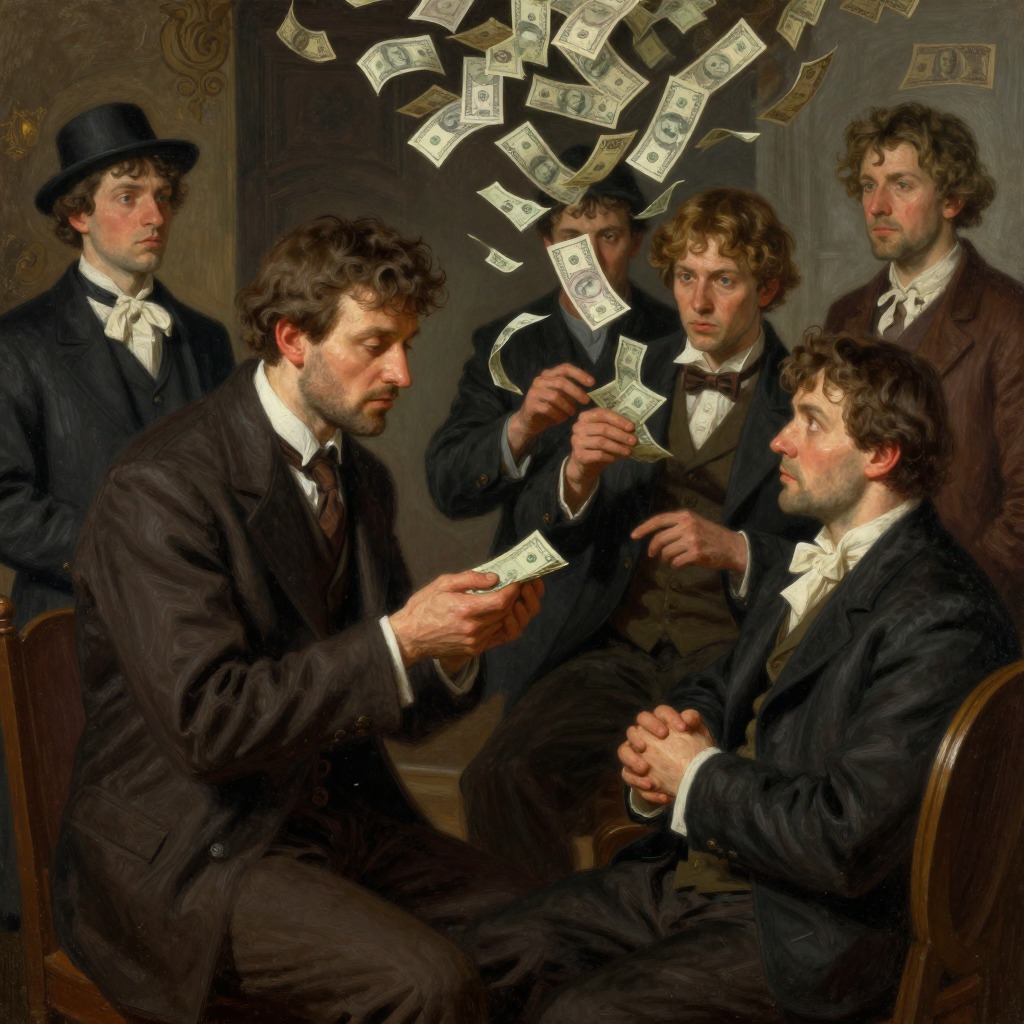
No sooner has Nikanor Ivanovich sat down to his dinner of pickled herring and borscht with a marrow bone than two citizens in white side-buttoned shirts arrive. They go straight to the privy and discover the wad, which has magically transformed from roubles into dollars. The chairman, in a panic, opens his briefcase to show the contract and the foreigner's passport as proof of his innocence, but finds nothing inside except a folding ruler. The documents, the money, and the theatre pass have all vanished. He is arrested, staggering like a drunk man, muttering about unclean powers. The trap is complete: the bribe, the evidence, and the very reality of his transaction have been erased, leaving him with only the damning foreign currency. His cries that enemies stuck him with it are met with the same bureaucratic indifference he himself once dispensed.
The Dream of the Currency Theatre
In Professor Stravinsky's clinic, Nikanor Ivanovich is visited by a vivid and terrifying dream. He finds himself in a theatre where the audience is composed entirely of bearded men sitting on the floor. A smooth, young master of ceremonies presides over a programme of forced currency surrender. Nikanor Ivanovich is called to the stage and, despite his protests that he has no currency, is publicly shamed and whistled at. The dream features a parade of other currency dealers, including the dignified Sergei Gerardovich Dunchil, whose hidden fortune is exposed by his mistress, and the repentant Nikolai Kanavkin, who is praised for turning over his dollars. The master of ceremonies delivers a lecture on the power of the human eye to detect lies, a grotesque parody of Soviet interrogation techniques. The dream culminates with cooks distributing soup and urging the audience to turn over their currency and go home. Nikanor Ivanovich wakes up crying out that he has no currency, that Pushkin should turn his over for them. The dream is a perfect, Kafkaesque inversion of his own reality: the bribe-taker is now the accused, the theatre of bureaucratic corruption has become a theatre of punishment.
Narrative Role and Thematic Significance
Nikanor Ivanovich Bosoy is a quintessential product of the Soviet system he serves. His greed is not exceptional but systemic, a normal part of the bureaucratic machinery. His downfall is engineered by Woland's retinue not as a punishment for his corruption per se, but as a demonstration of how easily the system's own logic can be turned against its functionaries. The bribe that becomes dollars, the contract that vanishes, the dream that mirrors his own reality—all are manifestations of the same unstable, theatrical quality that defines the Moscow of the novel. His story is a darkly comic parable about the emptiness of official power and the terror that lurks beneath the surface of everyday life. He is a man who believes in the solidity of paper—contracts, money, passes—only to discover that in Woland's world, paper is as mutable as a dream. His fate, like that of Berlioz and Rimsky, underscores the novel's central theme: that the reality constructed by power and fear is a fragile illusion, ready to be shattered by a touch of the supernatural.